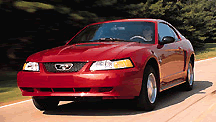
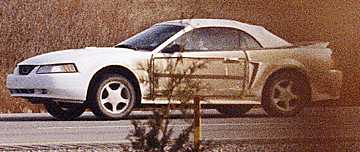
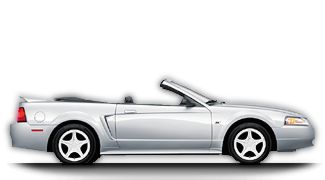
America's favorite pony car rolls into 1999 with freshened looks, modest suspension revisions,
and -- most important, considering the nature of the breed -- more ponies. The standard 3.8-liter pushrod V-6 and the GT's 4.6-liter SOHC V-8 both offer big output upgrades, the former as a result of a new
dual-runner intake manifold, the latter as a result of new cams, bigger valves, coil-on-plug ignition, and induction improvements. Results: the 3.8 generates 190 hp, 40 more than it did in '98 models, and
the 4.6 V-8 tops out at 260, a 25-hp gain. Although both engines still fall short in power to their counterparts in GM's Chevy Camaro/ Pontiac Firebird twins, the gap has closed considerably. A lower
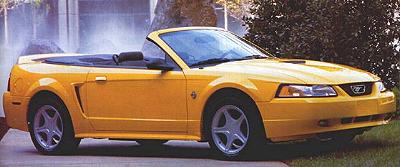
rear-axle ratio -- 3.27:1 for all models -- is expected to lend extra zeal to stoplight launches.The cosmetic updates are subtle but extensive. Ford has revised almost all of the Mustang's exterior
sheetmetal, adding character creases down the sides, redesigned side scoops, a new front fascia with wraparound headlights, new taillamps, and a new composite decklid. A 1.4-inch rear-track expansion adds a
more aggressive look to the going-away view by bringing the wheels out to the limits of the new fender flares. Beneath its new clothes, the Mustang continues to ride on one of the oldest rear-drive
chassis in the business, but a number of tweaks promise to keep it viable for a few more years. In addition to the broader rear track, Ford's chassis engineers have revised the spring rates, shock damping,
and anti-roll bars, and increased the drive-tunnel height at the rear axle to allow increased suspension travel -- all changes largely aimed at improving ride quality. The power steering boost curve has been
altered to provide better on-center feel, and changes to the steering rack and lower front control arms net a three-foot reduction in the Mustang's turning circle . The braking system has also received
attention. New twin-piston aluminum calipers squeeze the front rotors, and master-cylinder revisions are expected to improve modulation and pedal feel. For those who feel that live axles belong to a bygone
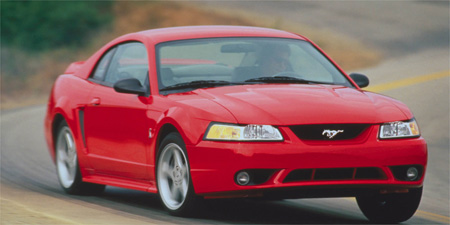
era, updates to the SVT Cobra will be an important step forward. Due as a mid-year model, Ford's reptilian pony will sport an independent rear suspension as well as supercharged power from its 4.6-liter DOHC
32-valve V-8. Interior changes -- new fabrics and front-seat contouring, plus new color schemes -- are minimal, but the addition of an extra inch of front-seat travel will be welcomed by taller drivers, as
will six-way power adjustability. Audio-system upgrades will also be welcomed by all. |